


MENTAL HEALTH IN THE CONTEXT OF MINDLESS SCROLLING AND MINDFUL SCROLLING ONLINE
- Dec 26, 2025
- 11 min read
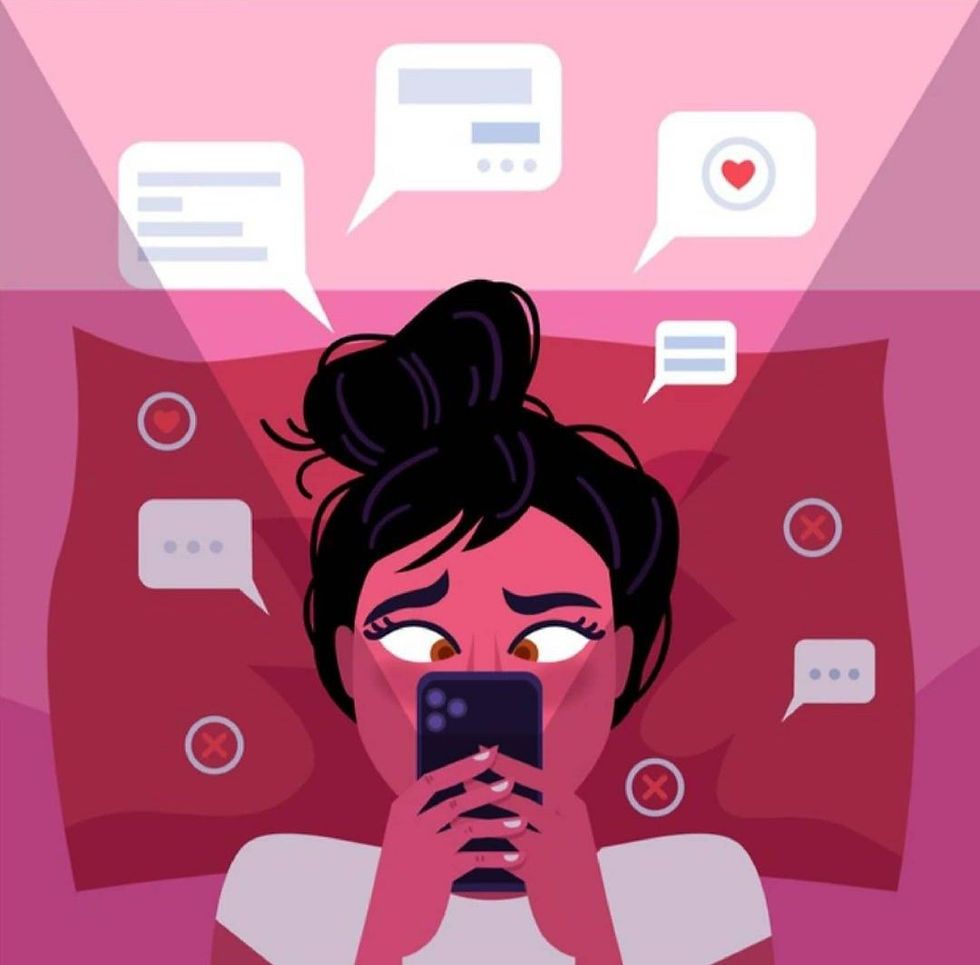
Article written in collaboration with @CUPOFTHERAPY
Introduction: Mental health and the digital environment
In recent years, the smartphone has become a constant presence in daily life, accompanying moments of pause, anticipation, boredom, and even emotional regulation. Continuous access to social media has transformed the way people seek distraction, connection, and emotional restraint, making the line between functional use and automatic use increasingly blurred. Many users report opening an app “just for a moment” and finding themselves, shortly thereafter, immersed in a prolonged and unintentional scroll. This phenomenon is not random, but the result of the interaction between psychological needs, individual vulnerabilities, and digital architectures designed to maximize dwell time (Montag et al., 2019).
Clinically, it is increasingly clear that how we use social media is at least as relevant as the time spent online. Recent studies highlight that passive and automatic use of social media is associated with worse mental health outcomes than active and intentional use (Verduyn et al., 2017). In particular, continuous, mindless scrolling can interfere with emotional regulation, time perception, and a sense of personal effectiveness. This necessitates shifting the focus from a moralizing narrative (“I use my phone too much”) to a deeper psychological understanding of digital behavior.
In this context, two opposing modes of interaction with social media emerge: mindless scrolling and mindful scrolling. The first represents a form of automatic and dissociative consumption of content, while the second introduces intentionality, awareness, and active choice. Understanding the differences between these two modalities is crucial for promoting prevention and psychoeducation interventions that support mental well-being. The goal is not to eliminate social media, but to integrate it more healthily into everyday life (Kross et al., 2021).
What is mindless scrolling?
The term mindless scrolling refers to a mode of social media use characterized by rapid, passive scrolling that lacks a conscious purpose. In this condition, attention is fragmented, and the mind tends to “shut down”, while the body automatically continues the scrolling gesture. The user loses track of time and often struggles to remember newly viewed content, a phenomenon that recalls mild but repeated dissociative states (Elhai et al., 2020). This type of experience does not coincide with relaxation, but rather with a temporary suspension of awareness.
Mindless scrolling has been aided by the development of specific digital design features, such as infinite scrolling, video autoplay, and intermittent notification systems. These elements exploit well-known principles of behavioral psychology, such as intermittent reinforcement, which keeps attention high even in the absence of real gratification (Alter, 2017). The user does not know what content will appear next, and this uncertainty keeps the reward circuitry active. Over time, this can lead to increasingly automatic and less regulated use of platforms.
Historically, the concept of "mindless scrolling" began to spread around 2015, paralleling the explosion of short, algorithmically personalized video content. These platforms have transformed the feed into a continuous and highly stimulating flow, reducing the natural moments of disruption that foster self-regulation. The result is an experience often referred to as a rabbit hole, in which the user is progressively absorbed without any real initial intention. This makes the behavior difficult to stop even when subjective pleasure decreases (Montag & Hegelich, 2020).
Effects of mindless scrolling on mental health
In the short term, mindless scrolling can serve as emotional anesthesia, allowing the person to temporarily distance themselves from unpleasant thoughts, stress, or boredom. However, once the scrolling session is over, many people report negative emotions such as guilt, frustration, and regret over time perceived as “wasted”. This experience is often accompanied by an internal conflict between the behavior implemented and unmet personal goals, such as work, rest, or relationships (Sagioglou & Greitemeyer, 2014).
Longitudinal studies show that doom scrolling and unintentional scrolling occupy a significant share of total time spent on social media. A study conducted on 1,315 adults, with over 67,000 daily assessments, highlighted that approximately 41% of social media time is dedicated to forms of automatic scrolling, distributed across frequent micro-sessions throughout the day (Meier et al., 2022). This fragmented use contributes to a constant feeling of distraction and a reduction in the quality of mental recovery. Over time, the accumulation of these micro-experiences can negatively impact overall affective well-being.
Psychologically, the central mechanism is goal conflict. The more time is spent on purposeless scrolling, the greater the perceived discrepancy between what the person would have wanted to do and what they actually did. This conflict fuels smartphone guilt, which in turn mediates a significant share of the negative effect on emotional well-being, estimated at between 28% and 38% (Meier et al., 2022). The effects are amplified in individuals with low self-control and in work contexts, where scrolling directly interferes with performance demands.
Neurobiology of scrolling
Neurobiologically, mindless scrolling activates the reward dopaminergic system, the same system involved in compulsive behaviors and behavioral addictions. Each new piece of content represents a potentially rewarding stimulus, keeping the brain in a constant state of waiting. This mechanism is known as intermittent reward and is particularly effective in supporting behavior over time (Volkow et al., 2017). Even when the content is not particularly interesting, anticipating the novelty is enough to keep attention active.
Another key factor is novelty bias, which is the brain's tendency to favor new stimuli over already known ones. Algorithmic feeds are designed to offer a continuous sequence of novelties, reducing the likelihood of cognitive satiety. This explains why it is difficult to stop scrolling even when you feel tired or bored. In parallel, reduced activation of prefrontal areas, involved in inhibitory control and planning, is observed (Firth et al., 2019).
The combination of dopaminergic hyperactivation and reduced prefrontal control leads to increased behavioral automatisms. In this state, the ability to evaluate the costs and benefits of the action decreases, making it more complex to voluntarily stop scrolling. The result is an increasing difficulty in stopping, even when the experience is no longer pleasant. This neurocognitive imbalance contributes to the perception of loss of control frequently reported by users.
Algorithms, social comparison and identity
Social media algorithms tend to favor emotionally activating content, such as fear, anger, idealization, and conflict. This type of content generates greater engagement, but also has a significant impact on users' psychological well-being (Brady et al., 2020). Repeated exposure to idealized images and polarized narratives fosters upward social comparison, which is associated with reduced self-esteem and increased personal dissatisfaction (Vogel et al., 2014).
In addition to social comparison, the algorithms reinforce confirmation bias, predominantly showing content consistent with existing beliefs and emotions. This can lead to a distorted view of reality, increasing polarization and reducing cognitive flexibility. Over time, the user may develop over-identification with unrealistic standards of success, beauty, or productivity. The feed thus becomes a distorting mirror that influences the way the person perceives himself and his own value.
This process has significant implications for identity construction, especially in young adults. Digital identity, continually exposed to implicit evaluations and comparisons, can become fragile and dependent on external feedback. In the absence of awareness, mindless scrolling amplifies these dynamics, making the online experience emotionally charged and potentially destabilizing. This underlines the importance of promoting more reflective and protective ways of using.
Mindless scrolling as a coping strategy
Under conditions of stress, anxiety, or emotional overload, mindless scrolling can function as a short-term coping strategy. Through scrolling, the person tries to avoid contact with unpleasant emotions, using the flow of content as a form of dissociative distraction. This behavior should not be interpreted as laziness or lack of will, but as an understandable attempt at emotional self-regulation (Kardefelt-Winther, 2014).
However, when used predominantly, this type of coping has several limitations. First, it does not promote the processing of the underlying emotion, but postpones it. Second, it increases mental fatigue, as the brain remains constantly stimulated with no real moments of recovery. Finally, it reduces contact with real needs, such as rest, authentic connection, or emotional support.
In the long run, frequent use of mindless scrolling as a coping strategy can become dysfunctional. The person risks progressively losing the ability to recognize and name his or her internal states. This makes it more difficult to adaptively intervene in the causes of stress. For this reason, it is essential to offer more conscious and sustainable emotional regulation alternatives.
What is mindful scrolling
Mindful scrolling represents a way of using social media based on intentionality, awareness, and active choice. Unlike mindless scrolling, it does not focus on reducing online time, but on the quality of the experience lived. The assumption is that social media can be neutral tools, the impact of which depends on how they are used (Kross et al., 2021).
A central component of mindful scrolling is intention before action. Wondering “why am I opening this app?” allows behavior to be brought back under conscious control. This simple question activates executive functions and reduces automatism. It also promotes use that is more consistent with the emotional needs of the moment.
Another key aspect is awareness of emotional reactions during scrolling. Observing how content makes us feel, without judgment, allows us to interrupt exposure to harmful stimuli. Finally, intentional exit from the app occurs by choice and not by attentional exhaustion. This strengthens the sense of agency and mastery.
Effects of mindful scrolling on mental health, cognition, and relationships
In mental health, mindful scrolling is associated with reduced levels of anxiety, stress, and depressed mood. Research shows that more conscious use of social media reduces exposure to negative content and decreases dysfunctional social comparison, two factors known to be linked to worse psychological outcomes (Verduyn et al., 2017; Vogel et al., 2014). Furthermore, mindfulness practices applied to digital media promote greater emotional regulation, reducing impulsive and ruminative reactions to online stimuli (Garland et al., 2015). This contributes to a more stable emotional state and a greater perception of subjective well-being.
Regarding cognitive functions, mindful scrolling counteracts the attentional fragmentation typical of automatic social media use. Neuroscognitive studies indicate that mindfulness improves attentional control and cognitive flexibility, promoting deeper information processing (Tang et al., 2015). Applied to scrolling, this awareness reduces digital multitasking and improves concentration and productivity in offline tasks (Mark et al., 2018). Furthermore, intentional use of digital content is associated with improved memory and comprehension performance, as the brain is not constantly overloaded with irrelevant stimuli.
On the level of social relationships, mindful scrolling promotes more meaningful and less quantitative interactions. Conscious choice of content and community reduces negative social comparison and fosters relational authenticity (Kross et al., 2021). This is associated with increased self-esteem, life satisfaction, and perception of social support (Twenge et al., 2018). Furthermore, by freeing up emotional and attentional resources, mindful scrolling facilitates the strengthening of offline bonds, improving the quality of real relationships. Social media thus becomes a relational tool, and not a mere attentional stimulator.
Digital Communities as a Protective Factor and Cup of Therapy
Research shows that the quality of the online experience is a more predictive factor for well-being than time spent on social media. In this sense, secure digital communities can be an important protective factor for mental health. These spaces offer emotional validation, stigma reduction, and a sense of belonging. Furthermore, they promote the normalization of psychological difficulties.
Cup of Therapy fits perfectly into the concept of mindful scrolling. It is a safe online community for mental well-being, where the user can scroll with conscience and without judgment. Here, emotions, anxieties, and paths of personal growth are shared, using hot tea as a metaphor for comfort and empathetic listening.
Cup of Therapy was created to address mental health not as taboo, but as a natural, and sometimes ironic, part of the human experience. The pun between “Cup of Tea” and “Therapy” evokes a daily pause for reflection. The narrator, a stray cat, symbolizes marginalization, anxiety, the search for affection, and playful uniqueness. This makes the space accessible, humane, and deeply supportive.
Mindful scrolling as a preventive intervention
Mindful scrolling can be conceptualized as a form of preventive digital mental hygiene intervention, aimed at reducing the negative impact of automatic social media use before dysfunctional patterns are structured. The literature suggests that mindfulness-based practices applied to the digital context promote greater awareness of online behaviors and a reduction in problematic smartphone use (Lanette et al., 2018; Rueda et al., 2020). Unlike restrictive interventions, mindful scrolling does not aim to eliminate technology, but to develop emotional and attentional self-regulation skills. This approach is particularly effective in a society where digital avoidance is neither realistic nor adaptive (Kross et al., 2021).
One of the central elements of mindful scrolling is the introduction of intention before action. Consciously wondering why you are opening an app activates metacognitive processes and reduces the likelihood of going into automatic mode (Shapiro et al., 2006). Self-regulation studies show that intentional awareness increases a sense of agency and reduces impulsive behaviors, including those mediated by technology (Brown & Ryan, 2003). Furthermore, actively choosing content and monitoring emotional reactions during scrolling promote greater coherence between internal needs and digital behavior.
From a preventive point of view, mindful scrolling can be integrated into both clinical pathways and psychoeducational interventions aimed at the general population. Small micro-practices, such as intentional exit from the app or post-use reflection (“how do I feel now?”), help break the cycle of overstimulation and mental fatigue (Rosen et al., 2014). Over time, these practices strengthen emotional regulation and a sense of mastery over the digital environment. In this way, mindful scrolling acts as a protective factor against stress, anxiety, and problematic social media use.
Bibliographic References
Alter, A. (2017). Irresistible: The rise of addictive technology and the business of keeping us hooked. Penguin Press.
Brady, W. J., Wills, J. A., Jost, J. T., Tucker, J. A., & Van Bavel, J. J. (2020). Emotion shapes the diffusion of moralized content in social networks. Proceedings of the National Academy of Sciences, 114(28), 7313–7318.
Brown, K. W., & Ryan, R. M. (2003). The benefits of being present: Mindfulness and its role in psychological well-being. Journal of Personality and Social Psychology, 84(4), 822–848.
Elhai, J. D., Yang, H., & Montag, C. (2020). Cognitive- and emotion-related dysfunctional coping processes: Transdiagnostic mechanisms explaining depression and anxiety’s relations with problematic smartphone use. Current Addiction Reports, 7(3), 410–417.
Firth, J., Torous, J., Stubbs, B., et al. (2019). The “online brain”: How the Internet may be changing our cognition. World Psychiatry, 18(2), 119–129.
Garland, E. L., Farb, N. A., Goldin, P. R., & Fredrickson, B. L. (2015). Mindfulness broadens awareness and builds eudaimonic meaning: A process model of mindful positive emotion regulation. Psychological Inquiry, 26(4), 293–314.
Kardefelt-Winther, D. (2014). A conceptual and methodological critique of internet addiction research. Computers in Human Behavior, 31, 351–354.
Kross, E., Verduyn, P., Demiralp, E., et al. (2021). Social media and well-being: Pitfalls, progress, and next steps. Trends in Cognitive Sciences, 25(1), 55–66.
Lanette, S., Hayes, G. R., & Mazmanian, M. (2018). How much is too much? Understanding social media use in the context of mindfulness. Proceedings of the ACM on Human-Computer Interaction, 2(CSCW), 1–21.
Mark, G., Iqbal, S. T., Czerwinski, M., & Johns, P. (2018). Bored Mondays and focused afternoons: The rhythm of attention and online activity in the modern workplace. Proceedings of the SIGCHI Conference on Human Factors in Computing Systems, 1–14.
Meier, A., Reinecke, L., & Meltzer, C. E. (2022). “Facebocrastination”? Predictors of using Facebook for procrastination and its effects on students’ well-being. Computers in Human Behavior, 128, 107132.
Montag, C., & Hegelich, S. (2020). Understanding dopamine-driven digital behavior. Nature Human Behaviour, 4(3), 231–232.
Montag, C., Lachmann, B., Herrlich, M., & Zweig, K. (2019). Addictive features of social media/messenger platforms and freemium games against the background of psychological and economic theories. International Journal of Environmental Research and Public Health, 16(14), 2612.
Rosen, L. D., Lim, A. F., Smith, J., et al. (2014). The distracted student: Does multitasking really hurt learning? Computers & Education, 77, 90–99.
Rueda, M. R., Pozuelos, J. P., & Cómbita, L. M. (2020). Cognitive neuroscience of mindfulness meditation. Neuroscience & Biobehavioral Reviews, 106, 109–120.
Sagioglou, C., & Greitemeyer, T. (2014). Facebook’s emotional consequences: Why Facebook causes a decrease in mood and why people still use it. Computers in Human Behavior, 35, 359–363.
Shapiro, S. L., Carlson, L. E., Astin, J. A., & Freedman, B. (2006). Mechanisms of mindfulness. Journal of Clinical Psychology, 62(3), 373–386.
Tang, Y. Y., Hölzel, B. K., & Posner, M. I. (2015). The neuroscience of mindfulness meditation. Nature Reviews Neuroscience, 16(4), 213–225.
Twenge, J. M., Spitzberg, B. H., & Campbell, W. K. (2018). Less in-person social interaction with peers among U.S. adolescents in the 21st century and links to loneliness. Journal of Social and Personal Relationships, 35(6), 1–18.
Verduyn, P., Ybarra, O., Résibois, M., Jonides, J., & Kross, E. (2017). Do social network sites enhance or undermine subjective well-being? Social Issues and Policy Review, 11(1), 274–302.
Vogel, E. A., Rose, J. P., Roberts, L. R., & Eckles, K. (2014). Social comparison, social media, and self-esteem. Psychology of Popular Media Culture, 3(4), 206–222.
Volkow, N. D., Wise, R. A., & Baler, R. (2017). The dopamine motive system: Implications for drug and food addiction. Nature Reviews Neuroscience, 18(12), 741–752.


Comments