


Attachment Theory and Styles: Foundations, Clinical Relevance, and Future Directions
- Sep 3, 2025
- 4 min read
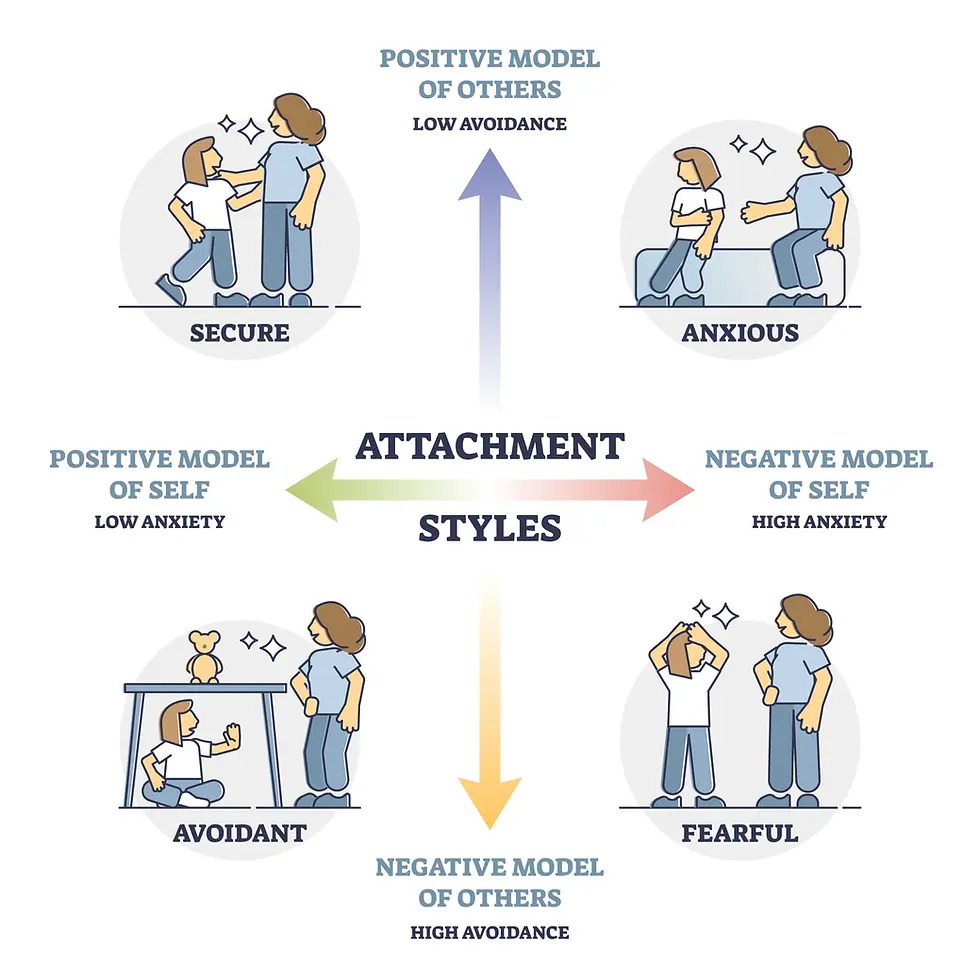
What Is Attachment?
Attachment refers to the emotional bond that develops between infants and their caregivers, shaping how individuals perceive themselves and others in relationships (Bowlby, 1969). It is considered a biologically driven system that ensures proximity to caregivers for survival, while also providing a foundation for emotional regulation, social competence, and resilience (Bretherton, 1992).
The Four Attachment Styles
Early observational work by Mary Ainsworth expanded John Bowlby’s attachment theory through her “Strange Situation” experiments, which identified distinct attachment styles in infants (Ainsworth et al., 1978). Over time, these patterns were extended into adulthood (Hazan & Shaver, 1987).
Secure AttachmentSecurely attached individuals view themselves as worthy of love and others as trustworthy. They balance independence with closeness and are more likely to regulate emotions effectively.
Anxious (Ambivalent) AttachmentCharacterized by fear of abandonment and heightened emotional reactivity, anxiously attached individuals often seek excessive reassurance in relationships.
Avoidant AttachmentAvoidantly attached individuals tend to minimize closeness, suppress emotional needs, and emphasize self-reliance, often due to early experiences of rejection.
Disorganized AttachmentIdentified later by Main and Solomon (1990), disorganized attachment is marked by contradictory behaviors (e.g., approaching but avoiding caregivers). It often arises from experiences of trauma or inconsistent caregiving.
Key Contributors to Attachment Theory
John Bowlby (1969, 1988): Originator of attachment theory, emphasizing the evolutionary and survival function of attachment bonds.
Mary Ainsworth (Ainsworth et al., 1978): Developed the Strange Situation, leading to the identification of secure, anxious, and avoidant attachment.
Mary Main & Judith Solomon (1990): Added the category of disorganized attachment.
Cindy Hazan & Phillip Shaver (1987): Applied attachment concepts to adult romantic relationships.
Contemporary Scholars such as Mikulincer & Shaver (2016) and Cassidy & Shaver (2018) have deepened our understanding of attachment’s role in emotional regulation, psychotherapy, and resilience.
Why Attachment Styles Matter
Attachment theory provides a framework for understanding personality development, interpersonal functioning, and vulnerability to psychopathology. Secure attachment is consistently linked with positive outcomes, including psychological well-being, effective coping, and strong social relationships (Mikulincer & Shaver, 2016). In contrast, insecure attachment is associated with heightened risk for mood disorders, relational conflict, and maladaptive coping (Cassidy & Shaver, 2018).
Clinically, therapists use attachment-informed approaches in modalities such as Emotionally Focused Therapy (Johnson, 2019), trauma-focused interventions, and schema therapy. By identifying attachment patterns, clinicians can tailor interventions to strengthen secure relational capacities in clients.
Recommendations for Further Research
Cross-Cultural Studies: Greater research is needed to explore how attachment styles manifest across diverse cultural contexts (Mesman et al., 2016).
Adult Attachment and Technology: Digital communication and online relationships present new contexts for attachment dynamics, warranting further study (Green et al., 2021).
Longitudinal and Neuroscientific Research: Studies using neuroimaging and genetic methods could illuminate the biological mechanisms of attachment, helping link early experiences with long-term outcomes (Long et al., 2020).
Clinical Interventions: Systematic reviews of attachment-informed interventions across populations could improve evidence-based practice and refine therapeutic models (Berlin et al., 2022).
Conclusion
Attachment theory, developed through the contributions of Bowlby, Ainsworth, Main, and others, continues to shape psychological research and clinical practice. Understanding the four attachment styles provides psychologists with a lens for interpreting developmental pathways and guiding treatment. As psychology evolves, further research into cross-cultural differences, digital relationships, and neuroscience will deepen our ability to apply attachment theory in meaningful and effective ways.
References
Ainsworth, M. D. S., Blehar, M. C., Waters, E., & Wall, S. (1978). Patterns of attachment: A psychological study of the strange situation. Lawrence Erlbaum Associates.
Berlin, L. J., Zeanah, C. H., & Lieberman, A. F. (2022). Prevention and intervention programs to support early attachment security: A move to the level of population health. Development and Psychopathology, 34(2), 631–647. https://doi.org/10.1017/S095457942100042X
Bowlby, J. (1969). Attachment and loss: Vol. 1. Attachment. Basic Books.
Bowlby, J. (1988). A secure base: Parent-child attachment and healthy human development. Basic Books.
Bretherton, I. (1992). The origins of attachment theory: John Bowlby and Mary Ainsworth. Developmental Psychology, 28(5), 759–775. https://doi.org/10.1037/0012-1649.28.5.759
Cassidy, J., & Shaver, P. R. (Eds.). (2018). Handbook of attachment: Theory, research, and clinical applications (3rd ed.). Guilford Press.
Green, J., Furrer, M., & Stieger, S. (2021). Attachment style and online communication: Implications for relationships in the digital age. Computers in Human Behavior, 119, 106716. https://doi.org/10.1016/j.chb.2021.106716
Hazan, C., & Shaver, P. R. (1987). Romantic love conceptualized as an attachment process. Journal of Personality and Social Psychology, 52(3), 511–524. https://doi.org/10.1037/0022-3514.52.3.511
Johnson, S. M. (2019). Attachment theory in practice: Emotionally focused therapy (EFT) with individuals, couples, and families. Guilford Press.
Long, M., Verbeke, W., Ein-Dor, T., & Vrtička, P. (2020). A functional neuro-anatomical model of human attachment (NAMA): Insights from functional neuroimaging studies of adult attachment. Behavioural Brain Research, 397, 112954. https://doi.org/10.1016/j.bbr.2020.112954
Main, M., & Solomon, J. (1990). Procedures for identifying infants as disorganized/disoriented during the Ainsworth Strange Situation. In M. T. Greenberg, D. Cicchetti, & E. M. Cummings (Eds.), Attachment in the preschool years: Theory, research, and intervention (pp. 121–160). University of Chicago Press.
Mesman, J., van IJzendoorn, M. H., & Sagi-Schwartz, A. (2016). Cross-cultural patterns of attachment: Universal and contextual dimensions. In J. Cassidy & P. R. Shaver (Eds.), Handbook of attachment: Theory, research, and clinical applications (3rd ed., pp. 852–877). Guilford Press.
Mikulincer, M., & Shaver, P. R. (2016). Attachment in adulthood: Structure, dynamics, and change (2nd ed.). Guilford Press.



Comments